Tests
For many graduate programs in psychology, especially master’s programs, the GRE is required. That being said, a good testing strategy is to only take the GRE if required or strategically helpful (check the programs you want first!).
- GRE Fee Reduction Program
- Free Peterson's Test Prep (make sure to be on campus or on a VPN and log in with your UCI email)
- For international students: confirm TOEFL/IELTS minimums early
Finding the right program
- Clarify your path early
- There are many degree options within the field of Psychology (PhD vs MA/MS vs PsyD) and many subfields (clinical, social, health, developmental, cognitive, I/O, forensic, public health, etc.). Try to figure out what you want early so that you prepare and apply to programs that fit your goals.
- For clinical PhD: confirm accreditation (APA or PCAS) and licensure compatibility in your target state; review APPIC internship match rates.
- For PsyD: weigh funding, tuition, and practicum quality; prioritize programs with substantial funding and strong match rates.
- Build your research experience if interested in a Ph.D. or research Master's
- Show methods breadth
- Survey design (Qualtrics/REDCap)
- Quantitative (SPSS/R/Python)
- Qualitative (NVivo/Dedoose)
- Psychophysiology (HRV/EDA)
- Include any measurable impacts on your CV.
- Show methods breadth
- Build applied experience for Psy.D. or more clinical programs
- Target programs by faculty fit
- Identify 2-3 potential advisors per program whose recent papers align with your interests and methods
- Track fit and programs in a spreadsheet
Doctor of Psychology (Psy.D.)
- Overview of the Degree
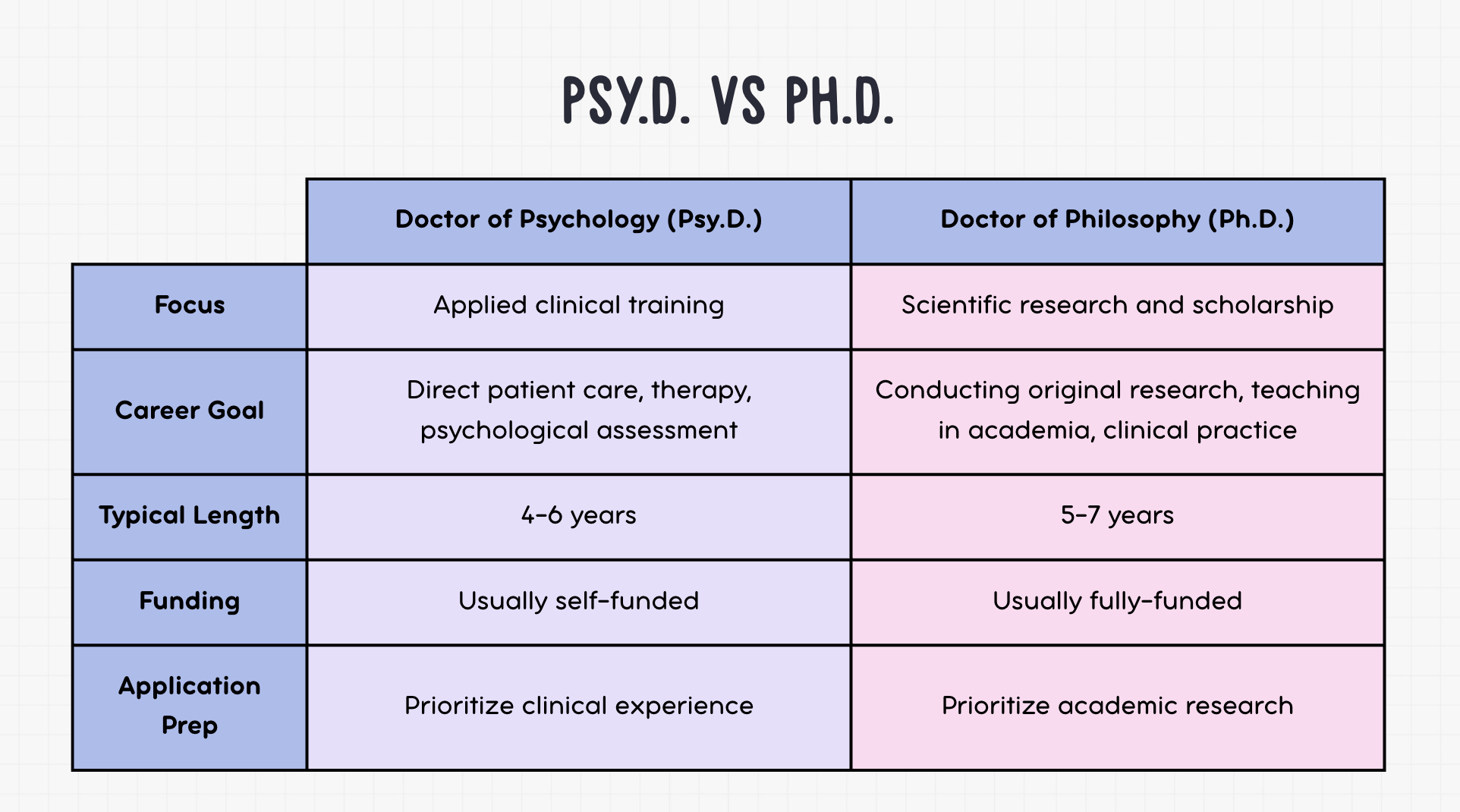
- The Doctor of Psychology (Psy.D.) is an applied professional doctorate designed for students whose primary career goal is to provide direct clinical services. While Ph.D. programs are heavily focused on producing original research, Psy.D. programs prioritize training students in therapeutic techniques, psychological testing, and working directly with patients in clinical settings.
- The Practitioner-Scholar Model
- Psy.D. programs operate on what is called a "practitioner-scholar" model. This means students are trained to understand and consume research, learning how to apply existing scientific findings to clinical practice instead of spending their time conducting research themselves. If your goal is to become a practicing therapist, clinical psychologist, or assessment specialist, and you are not very interested in research, a Psy.D. offers highly specialized, hands-on clinical training.
- Preparing for a Psy.D. Program
- Because the focus of a Psy.D. is on practice, admissions committees typically look for strong interpersonal skills and applied experience. While having some research experience is helpful to understand the science, the best thing you can do to prepare for a Psy.D. is to gain direct human services experience. Volunteer work, peer mentoring, behavioral technician roles, or internships in mental health and social service settings will be the strongest additions to a Psy.D. application.
- Funding and Financial Considerations
- A major distinction between Ph.D. and Psy.D. programs is how they are funded. Most reputable psychology Ph.D. programs offer full funding (tuition waivers and stipends in exchange for research or teaching assistantships). On the other hand, Psy.D. programs generally do not offer full funding and are more like medical or law schools when it comes to financials. Students are typically responsible for covering their own tuition and living expenses through student loans, personal financing, or external scholarships.
- Accreditation
- When researching Psy.D. programs, it is very important to make sure the program is accredited by the American Psychological Association (APA). Attending a non-accredited program could severely limit your ability to secure clinical internships, obtain state licensure, and find employment after graduation, so make sure to check programs before applying!
UCI Post-Baccalaureate Program in Psychology
- Program Overview
- The UCI Post-Baccalaureate Program in Psychology is a customized certificate program that integrates upper-division psychology coursework with research and internship experiences. It is designed to serve as a preparatory program for students who need additional academic or practical training before applying to graduate school, medical school, or transitioning into a psychology-related career.
- Differences From a Master's or Ph.D.
- Unlike a Master's or Ph.D., which are often terminal degree programs with fixed curricula and thesis or dissertation requirements, a post-baccalaureate program is a non-degree preparatory experience that is focused on skill-building.
- Instead of following a strict degree track, you work one-on-one with a faculty advisor and build a schedule that specifically addresses the gaps in your background.
- It is ideal for people whose bachelor's degree is not in psychology, or for psychology majors who need to boost their academic record, gain more specific research experience, and secure stronger letters of recommendation before applying for more competitive graduate programs.
- Additionally, the focus is on completing any necessary prerequisite coursework, gaining applied or research experience, and preparing strong applications for graduate school instead of working on a major capstone research project.
- Unlike a Master's or Ph.D., which are often terminal degree programs with fixed curricula and thesis or dissertation requirements, a post-baccalaureate program is a non-degree preparatory experience that is focused on skill-building.
- Financial Considerations
- It is important to note that the post-baccalaureate program is not funded. Furthermore, because it is a certificate program and not degree-granting, students do not qualify for federal or state financial aid (such as FAFSA, Pell Grants, or Cal Grants). Students are generally responsible for covering the costs out-of-pocket or through private educational loans.
- Program Benefits and Departmental Resources
- Students enrolled in the post-bacc program receive many of the same privileges as graduate students, including:
- Academic and Application Mentorship
- Dedicated faculty advising help you select the right courses, secure research assistantships, and navigate the graduate application process
- Professional Development Funding
- Eligibility to apply for up to $1,600 in awards to cover academic society memberships, conference registration and travel, or specific training fees
- Departmental Access
- Full use of the graduate student computer lab (including free printing) and invitations to attend weekly departmental colloquia
- Exclusive Career Programming
- Access to specialized career counseling and semi-quarterly career panels featuring graduate admissions personnel, UCI Psychology professors, and practicing clinicians
- Academic and Application Mentorship
- Students enrolled in the post-bacc program receive many of the same privileges as graduate students, including:
Application Materials
- Tailor your statements
- Statement of Purpose
- 1-2 pages
- Brief motivation, specific past training, 2-3 potential advisors with paper references, methods you’ll bring, future directions
- Clinical Personal Statement
- Articulate theoretical orientation, population interests, practical/training goals, supervision needs
- DEI statement
- Connect lived experience to structural analysis and concrete actions/outcomes
- Read more information about personal statements vs. statements of purpose here
- Statement of Purpose
- Choose and polish a writing sample
- Pick your strongest empirical or applied piece; anonymize and tighten methods and results
- If you don’t have one, develop a short empirical paper (secondary analysis) or a polished program evaluation/report
- Letters of recommendation
- Request 2-3 letters 8-10 weeks before deadlines. Provide CV, unofficial transcript, SOP draft, and a “brag sheet” of achievements
- For research programs, try to get at least one letter from a professor you have done research with who can speak to your methodological and analytical skills. For clinical programs, try to get at least one letter from a clinical supervisor who can speak to your interpersonal skills and applied work.
- Waive your right to read letters; send reminders 2 weeks and 3 days before due dates
- Request 2-3 letters 8-10 weeks before deadlines. Provide CV, unofficial transcript, SOP draft, and a “brag sheet” of achievements
Make your application stand out
- Reach out to professors you are interested in (briefly and professionally)
- Email 1-2 months before deadlines
- 2 short paragraphs on your interests and methods, 1-2 references to their recent papers, and a polite question about taking students
- Attach a 1-page CV
- Prepare for interviews
- Know the lab’s last few papers
- Be ready to discuss your projects and methods (design decisions, failures, iterations, etc.).
- Prepare questions about mentorship style, authorship policies, lab culture, resources, and training milestones
- For clinical programs, ask about practicum selection, supervision model, case loads, time tracking, and match preparation
Other advice
- Understand funding and offers
- Decode packages: stipend, tuition remission, fees, health insurance, guaranteed years, summer support, expected TA/RA load
- Compare cost of living and hidden fees
- For example, ask current students about the actual workload
- Common pitfalls to avoid
- Generic SOPs that don’t name faculty
- Misrepresenting roles (e.g., “diagnosed” without appropriate training)
- Ignoring funding details
- Applying to too many programs without tailored materials