
Writing Your Graduate School Essays: Personal Statements and Statements of Purpose
Getting Started
Writing about yourself can be one of the hardest parts of applying to graduate school. That being said, your essays are fantastic opportunities to truly show who you are beyond your GPA, transcripts, and test scores. They also give you the opportunity to expand on your background and highlight the most relevant skills and experiences you have had. Expect to write 5-8 drafts and start early (usually around two to four months before deadlines) to ensure you have plenty of time to revise.
As you are writing, you can keep a master outline that can be used for each essay. Your core statements will usually be around 80% the same for each program, but the other 20% should be very specifically and carefully tailored for each specific school.
What is the Difference?
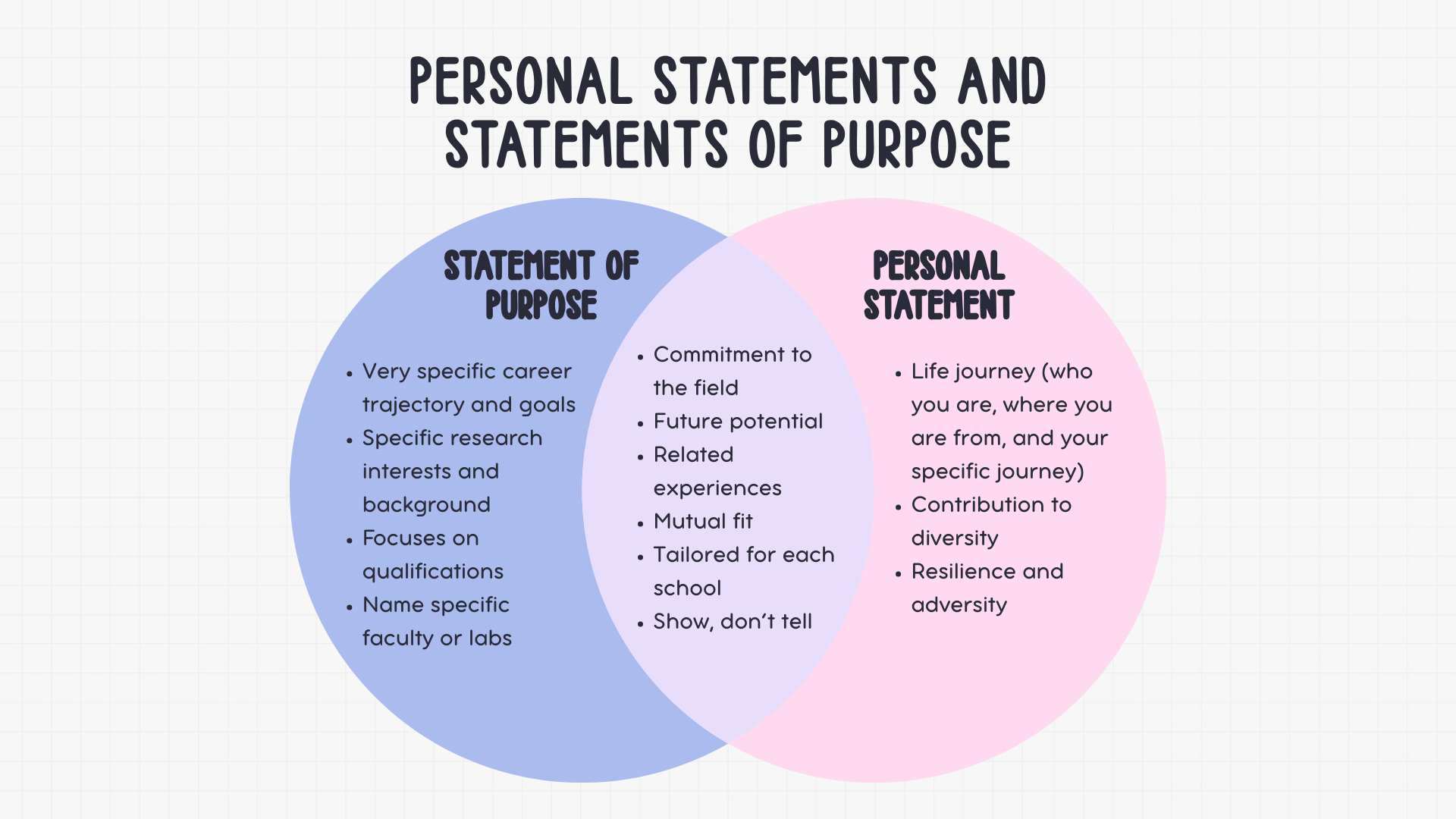
Most graduate programs will ask for a Statement of Purpose (SOP), a Personal Statement, or sometimes both. While they have a lot of similarities, they also serve two different purposes, and it is important to know the distinctions. Note: Always check the specific program guidelines, as some schools use these terms interchangeably or have specific prompts they would like you to answer instead.
Statement of Purpose (SoP)
The SoP is highly focused on your professional and academic trajectory. It outlines your research interests, career goals, and how ready you are to pursue and complete graduate-level work. It should specifically address why you want the specific degree and program you are applying for. The main focus of this essay should be the present and the future.
What to include:
- Academic and Research Background: Highlight your intellectual and academic journey. Discuss specifically any research you have done, your role in research labs, your honors thesis, or relevant field study placements, if any of these are applicable.
- Specific Research Interests: Be very specific when it comes to your research interests. It is very important to mention the specific topics and/or sub-populations you are interested in.
- Fit with the Program: Mention why you are applying to that specific school and program. Name one or two faculty members whose research aligns with yours and explain how working with them would advance your goals.
- Career Trajectory: Briefly explain how this specific Master's or Ph.D. program is the next step for your future career and how it aligns with your goals.
Personal Statement
The Personal Statement is about your individual journey. It provides context for your academic record and shows the committee your resilience, your unique perspective, and the underlying motivations that drive your passion for the field. The main focus of this essay should be the past and the present. These essays are more similar to the essays you wrote to get into UCI and are more commonly used for scholarship applications.
What to include:
- Your Story: What sparked your interest in the field? Focus on any defining moments, classes, or personal experiences.
- Overcoming Adversity: If applicable, discuss any obstacles you have navigated to get to where you are. This could include being a first-generation college student, balancing multiple jobs while in school, or overcoming systemic barriers. Show how these challenges have made you who you are and built your resilience.
- Diversity and Contribution: How will your unique background, perspective, or life experiences contribute to the diversity of your graduate school cohort and future profession?
Common Structure of a Successful Essay
- Hook/Intro: Open with a statement about your decision to apply and your key goals. You can incorporate a brief narrative if you want to highlight a unique characteristic, but do not spend too long on it. If the narrative does not sound authentic, don't force it.
- Background: Provide a critical evaluation of your skills and milestones in your learning. Depending on the program, emphasize your education, research experience, work, or personal attributes.
- Reasons for Applying: Why do you want to pursue an advanced degree? Why this specific discipline? If you are applying to programs where you work with a specific lab or mentor, you should explicitly mention and demonstrate how your research interests and experiences align with the specific faculty. You can also mention specific resources at the school that stand out to you or any other relevant reason you would like to attend.
- Conclusion: Restate your short-term and long-term goals. Identify the school by its full name at the beginning and end to show that you are fully invested in its program.
Organization Strategies
When outlining your draft, consider which organizational strategy highlights your strengths and experiences best
- Thematic: This is often the best strategy for students, as the flow is very natural and it can prioritize your most important experiences, regardless of when you completed them. Following this structure, you should organize your essay around 2-3 core themes you want the committee to take away about you. Use your experiences to demonstrate those themes, putting emphasis on what you learned, why it matters, and how you will use those skills in the future. Try to give your themes equal weight, placing the most important first.
- Chronological: This structure is organized around when experiences occurred. Focus on how past and present experiences have linearly led to your future goals. This is a great option if your experiences followed a very concrete and straightforward path.
Other General Tips
- Show, Don't Tell: Instead of simply stating skills such as research or public speaking, state examples and analysis. For instance, you can talk about specific presentations you have done, where you did them, and in front of how many people. For research, mention the specific topic of research and the methodology you used.
- Tailor Every Essay: Never send a generic essay to multiple schools. It is very easy to tell when an essay was not tailored. It is super important to explicitly connect your goals to the resources and faculty at their institution. You want to show that you have done your research and are specifically interested in that program.
- Write for Skimmers: Admissions committees read hundreds of personal statements, so unfortunately, they are often just briefly skimmed. It is very important to make sure each sentence is easily understandable and adds value to the overall essay. Additionally, the first few sentences of a paragraph should encapsulate the main point, expanding from there.
- Length: Unless otherwise specified (always check program deadlines), a good length for a personal statement or SoP is typically around two pages. Include only what is directly relevant.
- Deciding Which Experiences to Include: Do not list every experience you have had. Listing too many experiences can dilute the most important ones. To help figure out which experiences you want to include, it can be helpful to list important experiences from your CV, rank them by relevance, and then cut from there. Focus deeply on 2-3 (maybe 4) big, highly relevant experiences.
- Proofread, Proofread, Proofread: These documents should be free of grammatical errors and be easily understood. Have multiple people review your work, including faculty mentors, graduate students, friends, family, and professionals such as our career services peer educators or UCI's Writing Center staff.
Want help getting started or need a second pair of eyes on your draft?
Wherever you are in the process, come meet with us to brainstorm topics, structure your essays, or review your current drafts!