
Two of the most common paths we see in our Psychology students are the Master of Social Work (MSW) and the Master's in Marriage and Family Therapy (MFT). Here is a comprehensive overview of what each program entails and how to navigate the application process.
Understanding the MSW
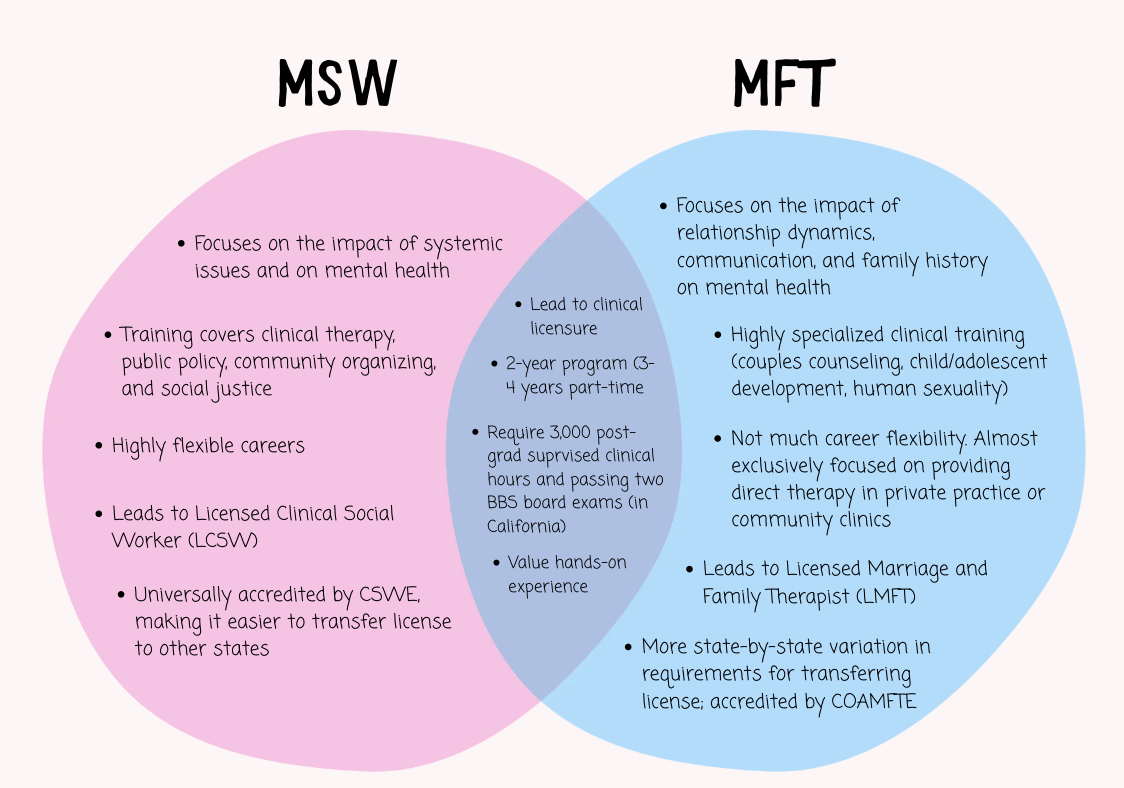
The MSW is a highly versatile degree that is focused on people and their environments. Social workers are trained to assess how systemic factors (poverty, discrimination, housing instability, community resources, etc.) impact an individual's mental health.
- Curriculum: MSW coursework covers a broad spectrum. Students take clinical classes on diagnosing mental illnesses and therapeutic interventions alongside courses in social welfare policy, community organizing, and systemic advocacy.
- Fieldwork: Programs typically require two internship placements, often splitting time between a clinical setting (e.g., a community clinic) and a larger, more macro-level setting (e.g., a non-profit).
- Career Trajectories: MSW graduates have a lot of career flexibility. Many open private practices as Licensed Clinical Social Workers (LCSW), but they are also highly sought after for medical social work (especially in hospitals and the VA), school social work, child welfare administration, and public policy.
- Personal Statement Ideas: Committees often look for a demonstrated commitment to social justice, advocacy, and a passion for working with marginalized or vulnerable populations.
- Why choose an MSW over an MFT? You should choose an MSW if you want maximum career versatility. While an MSW allows you to become an LCSW and provide direct clinical counseling, it also trains you in macro-level social work. This means you have the flexibility to pivot your career into hospital administration, public policy, non-profit work, community organizing, or school social work without needing another degree. It is ideal for students who view mental health through a systemic, social justice lens and want to keep their career options open.
Understanding the MFT
The MFT is a very specialized clinical degree, working specifically on family systems. Even when treating individuals, MFTs are trained to view clients' struggles through the lens of interpersonal relationships, communication patterns, and family history.
- Curriculum: MFT coursework is highly clinically focused. Students take courses on psychopathology, child and adolescent development, human sexuality, couples counseling, and group therapy, with little to no focus on public policy or the macro-level advocacy that the MSW has.
- Fieldwork: Practicums are strictly clinical. Students focus on accruing direct client contact hours, often with specific requirements to log hours treating couples and family units.
- Career Trajectories: The MFT career path almost exclusively centers on providing direct therapeutic care. Common work settings include private practice, residential treatment facilities, and specialized community mental health agencies.
- Personal Statement Ideas: Committees look for a strong interest in interpersonal dynamics, relational healing, and understanding of how family systems shape behavior.
- Why choose an MFT over an MSW? You should choose an MFT if you are 100% certain that your career goal is to provide direct clinical therapy. MFT programs bypass the broader social policy and administrative coursework required in MSW programs, allowing you to focus purely on counseling techniques, relationship dynamics, and treating clients through a family systems framework. It is ideal for students who want a very focused clinical education tailored specifically for private practice, couples counseling, or specialized family therapy.
Getting Licensed in California
Since many students complete their master's in California, most graduates seek licensure through the California Board of Behavioral Sciences (BBS). The post-graduation path is similar for both degrees:
- Registration: Graduates register with the BBS as either an Associate Clinical Social Worker (ASW) or an Associate Marriage and Family Therapist (AMFT).
- Clinical Hours: Associates must accrue 3,000 supervised clinical hours, which typically takes 2 to 4 years of full-time employment.
- Examinations: Candidates must pass the California Law and Ethics Exam, followed by the BBS Clinical Exam for their specific license.
Transferring to Other States
For students who plan to or are thinking about practicing outside of California, the MSW is widely considered the more portable degree. MSW programs are universally accredited by the Council on Social Work Education (CSWE) and utilize the national ASWB clinical exam, making it relatively straightforward to transfer an LCSW license to different states. The MFT has a lot more state-by-state variation in degree requirements and clinical hour tracking. While many programs are accredited by the Commission on Accreditation for Marriage and Family Therapy Education (COAMFTE), California's BBS has its own specific standards. Students who are planning to go elsewhere after graduate school should research their destination state's licensing board early.
When and How to Apply
- Timing: Graduate applications typically open in September or October of your senior year. Deadlines for Fall admission usually fall between December and February (though it depends on the program, so check early!). To transition immediately after graduating from UCI, begin preparing materials the summer before your senior year.
- Gain Relevant Experience: Both programs highly value hands-on experience. Leverage your field study, volunteer in clinical settings (e.g., crisis hotlines or hospitals), or seek out roles in behavioral health, peer mentoring, or community services.
- Check Prerequisites: While many programs accept students from a variety of academic backgrounds, some require specific undergraduate coursework. Luckily, our Psychology major typically covers these prerequisites, but it is always best to check the specifics of each program to make sure!
- The GRE: Most MSW and MFT programs have eliminated the GRE requirement, but always verify this on individual program websites before you apply.
- Secure Strong Recommendations: You will typically need two to three letters of recommendation. For professional programs like an MSW or MFT, aim for a balanced mix. If a program requires three letters, a standard approach is to request two from faculty who can speak to you as a student, and one from a professional or field study supervisor who can vouch for your clinical potential.
- In addition to letters of recommendation, you will typically need a Personal Statement (check the prompts of your specific programs), a polished resume, and official transcripts.
Still Deciding? Let's Talk!
Trying to create a timeline, write your statements, or still figuring out which program is best for you? Come meet with us to help plan and build your applications, or to narrow down your top programs of interest.